Friday, August 8, 2014

maybe this is the meat of it

Color- as oasis
Reflection - mirror as something one is used to using, but distorting reality, or re-presencing reality
Light and heat - materials of transformation: corrosive, preservative
pink and gold - chakra points

Blue/Mirror
Mirror/Blue

Black/Mirror
Mirror/Black

With red, blue, pink, gold

Fra Angelico Blue

I signed up for updates from Master Pigments years ago, thinking I would make my own paint using ancient formulas and techniques. Although I didn't, and still don't, make my own paint, I'm still fascinated by the process of mineral extraction, and transformation of one material into another.

Recently, they sent a video link on how they extract Lapis Lazuli to make Fra Angelico Blue.

I want.
X


red square

The Mirror House inspires me to think about this in a greater way.
Why does the square have to be red, on a mirrored ground?
What would it be like to have the materials reversed?
Hmmmm.....
!

Mirror House


Artist Ekkehard Alteburger produced ‘Mirror House’ in 1996 during his student days at Edinburgh College of Art. At the time, he was studying sculpture and he was invited to take part in an exhibition on the Isle of Tyree, which is a flat, wind swept island on the southern Hebrides, Scotland. What looks more like a Photoshop exercise is actually a construction of large mirror sheets on a steel frame. The work sits in a shallow lake, and the house is reflecting the Atlantic Ocean. The project influenced and guided Altenburgers artistic career ever since. He is currently living and working in London.
All images © Ekkehard Alteburger

...and now, getting out of the cycle of self-pity


Wabi-Sabi Spiritual Values

What are the lessons of the universe?
Truth comes from the observation of nature. The Japanese have tried to control nature where they could, as best they could, within the limits of available technology. But there was little they could do about the weather—hot and humid summers, cold and dry winters and rain on the average of one out of every three days throughout the year, except during the rainy season in early summer when everything is engulfed in a fine, wet mist for six to eight weeks. And there was little they could do about the earthquakes, volcanic eruptions, typhoons, floods, fires and tidal waves that periodically and unpredictably visited their land. The Japanese didn’t particularly trust nature, but they learned from it. Three of the most obvious lessons gleaned from millennia of contact with nature (and leavened with Taoist thought) were incorporated into the wisdom of wabi-sabi:
1. All things are impermanent. The inclination toward nothingness is unrelenting and universal. Even things that have all the earmarks of substance—things that are hard, inert, solid—present nothing more than the illusion of permanence. We may wear blinders, use ruses to forget, ignore, or pretend otherwise—but all comes to nothing in the end. Everything wears down. The planets and stars, and even intangible things like reputation, family heritage, historical memory, scientific theorems, mathematical proofs, great art and literature (even in digital form)—all eventually fade into oblivion and nonexistence.
2. All things are imperfect. Nothing that exists is without imperfections. When we look really closely at things we see the flaws. The sharp edge of a razor blade, when magnified, reveals microscopic pits, chips and variegations. Every craftsman knows the limits of perfection: the imperfections glare back. And as things begin to break down and approach the primordial state, they become even less perfect, more irregular.
3. All things are incomplete. All things, including the universe itself, are in a constant, never-ending state of becoming or dissolving. Often we arbitrarily designate moments, points along the way, as “finished” or “complete.” But when does something’s destiny finally come to fruition? Is the plant complete when it flowers? When it goes to seed? When the seeds sprout? When everything turns into compost? The notion of completion has no basis in wabi-sabi.
“Greatness” exists in the inconspicuous and overlooked details. Wabi-sabi represents the exact opposite of the Western ideal of great beauty as something monumental, spectacular, and enduring. Wabi-sabi is not found in nature at moments of bloom and lushness, but at moments of inception or subsiding. Wabi-sabi is not about gorgeous flowers, majestic trees or bold landscapes. Wabi-sabi is about the minor and the hidden, the tentative and the ephemeral: things so subtle and evanescent they are invisible to vulgar eyes.
Like homeopathic medicine, the essence of wabi-sabi is apportioned in small doses. As the dose decreases, the effect becomes more potent, more profound. The closer things get to nonexistence, the more exquisite and evocative they become. Consequently to experience wabi-sabi means you have to slow way down, be patient and look very closely.
Beauty can be coaxed out of ugliness. Wabi-sabi is ambivalent about separating beauty from non-beauty or ugliness. The beauty of wabi-sabi is, in one respect, the condition of coming to terms with what you consider ugly. Wabi-sabi suggests that beauty is a dynamic event that occurs between you and something else. Beauty can spontaneously occur at any moment given the proper circumstances, context or point of view. Beauty is thus an altered state of consciousness, an extraordinary moment of poetry and grace.
To the wealthy merchants, samurai and aristocrats who practiced tea, a medieval Japanese farmer’s hut, which the wabi-sabi tea room was modeled on, was a quite lowly and miserable environment. Yet, in the proper context, with some perceptual guidance, it took on exceptional beauty. Similarly, early wabi-sabi tea utensils were rough, flawed and of undistinguished muddy colors. To tea people accustomed to the Chinese standards of refined, gorgeous and perfect beauty, they were initially perceived as ugly. It is almost as if the pioneers of wabi-sabi intentionally looked for such examples of the conventionally not-beautiful—homely but not excessively grotesque—and created challenging situations where they would be transformed into their opposite.
(Source: mindful.org)

...but this is encouraging

"I have done a lot of work which presents a visual disorder that is actually the representation of a mental order. It’s just a question of knowing the rules of the game. Someone who doesn’t know them will never see the order that reigns in things. It’s like looking at a starry sky. Someone who does not know the order of the stars will only see confusion, whereas an astronomer will have a very clear vision of things.”
— Alighiero Boetti

Thanks Hayley

insomnia

Up again, 10:21pm. Not tired at all.
Nurse called back: "nothing's wrong", except why do I still feel so weak, so exhausted, unable to catch my breath, and unable to sleep? The Lyme panel came back negative, except Lyme can take 6 - 8 weeks to show up on a test. Great. Now what?

When I'm awake, I don't feel awake, and when I'm supposed to be sleeping, I don't feel tired. I wake up almost every night between 3AM - 5AM. I'm almost always short of breath. I stopped drinking coffee a week ago, I stopped eating gluten again, also a week ago, I started taking Vitamin D, B, and Omega 3, 6, 9.

They didn't check thyroid function or vitamin deficiency..so why or how is a CBC considered complete? They said to come back next week for another blood test.

In the meanwhile, what should I do?
Treat something that doesn't show up on a test?
Trust my intuition that something is still wrong even though nothing is coming up?
Acupuncture? For what main complaint: exhaustion everywhere and diffuse pain in most joints?
Massage? Energy work? Why?
I'm at a loss. It feels like I'll never get better.

The only energy I had was to rip up my drawings and tape them back together again. I don't even think I was truly following a chance game, if I'm the one who chose the drawings to be cut up. Oy.

Wednesday, August 6, 2014

...and also a big painting

Reflection/Absorption
(in process)

Chance Cuts

A chance game (thanks John Cage!)
Cut up drawings into four equal parts.
Place them in two separate piles (in this case, next to each other). They can be shuffled, or left as is.
Turn the images face down
Take the top sheets of paper, combine them. In this case, I taped them as I found them.
Repeat until two piles become one.


Friday, August 1, 2014

Cleansing Forefathers


In Cleansing Forefathers, I plan to carve, mold, reproduce soap portraits of our country’s forefathers and install them in public restrooms for public use at least 232/243/272/292 times. The number represents the over two hundred three hundred girls that went missing over four months ago in Nigeria.  

Thursday, July 24, 2014

$PEAK OUT


The light of George

Wednesday, July 23, 2014

A not so sure George


(I got the Millay check today, after waiting for it this past month. I can't help to think that it was meant to come this particular day.)

I want to track it's spending, the first three dollars go to the following;
 Diane Jacob's project $PEAK OUT:

The staggering statistic that around the world at least 1 woman in every 3 has been beaten, coerced into sex or otherwise abused in her lifetime requires us to act. 

$PEAK OUT is about engaging the public to respond to this crisis and ending the silence. Through outreach, people from all walks of life will participate and react to these atrocities with their voices on their money. This act of transforming individual statements and drawings into a collective artwork is compelling. The power is in the numbers, yet what touches the heart is each handwritten expression. Money buys inequality, injustice, and violence. Money procures policy-making and military action. Money captures attention.
 
The goal for $PEAK OUT is to generate a paradigm shift. Imagine thousands, hundreds of thousands, a million - even a billion’s worth of bills hung on austere white museum walls, in university galleries, and community public spaces. Massive displays of money generate a visceral reaction. At closer inspection, individual messages are revealed. The work is unified by the continuity of material and method. Each personalized script is precisely cut. 


Tuesday, July 22, 2014

Anitra


You, madam, are the point

whatisthepointvideo from Tereza Swanda on Vimeo.

I love you, dear soul. Rest in peace.

Wednesday, July 16, 2014

my stain and participation, blue to red


Impermanent foundation


This was the house I called home. I spent hours observing every slug and snail in the yard. I climbed the cherry tree at the edge of the property and picked forest strawberries on the side of the house while regular berries had a devoted plot in the back.We played with a marble on the winding staircase between the floors, to the great dismay of our grandmother who worried about someone slipping on the glass ball. (No-one ever did.) I can describe in detail the furniture in every room on that top floor that now the air flows through. 

This building was built by the Germans in the war. It has a vantage point of overlooking the town in the valley. My grandfather (by marriage) acquired this house for his good service after the war. He had enormous scar along the edge of his belly. It cut into his round flesh right along his ribs. My grandmother acquired him after both had devoted themselves to others, had children, but were reunited in their forties, too old to have children of their own. He rocked me on his knees and I thought I had his blue eyes, not yet knowing the lineage. (I didn't look into my fathers eyes to discover the blueness there.)

The building was leveled last week. 


MVI 4811 from Tereza Swanda on Vimeo.

Friday, July 11, 2014

Our Red Books

Our red books
Two Aspects Of The Same Thing In The Same Space
Oil, Pencil, Paper on Canvas
48" x 60"
Studio walls and table
24/7, 365
Used dishtowels stretched over wood
8" x 8" each
Working on creating one for each day, each meal, each day
24/7, 365 detail
Used dishtowels stretched over wood
8" x 8" each

studio wall
Possible sketches for larger porcelain pieces

studio wall

Speak With The Hand (After Tapies)


Thursday, July 10, 2014

questioning the forefathers


Questioning the spikes of this forefather
(That strange ruffle is in almost every painting,etching of him)

Also which was his right side?
The dollar bill seems to be just a horizontal flip of his paintings- thus:


(Always with Anitra on my mind and her flipped Mandelas)

Creating soaps of our forefathers, to be installed for use in public restrooms.


Tuesday, July 8, 2014

reveiwing Montessori

Preparation for human society is based on the activities of children who act, urged on by the needs of their nature, in a limited world corresponding to the frame.

Monday, July 7, 2014

Conclusions (from Millay) and the Beginning


1.                                                                                                                                 


2.                                                                                                                                 


3.                                                                            


4.                                                                           


5.                                                                                                                               


6.                                                                                                                               


7.                                                                                                                              


1.      Untitled, (Girl Within)
 Unfired clay on plaster, 2014
 Housedress on US flag, 2008

2.     Untitled, (Girl)
My daughter’s left over banana stubs and cleaning rag over clay bust, 2014

3.     Untitled (Mutual Cleanse)
Carved and painted soap, washed, 2011-present

4.     Untitled (Objects)
Gauze, 2011

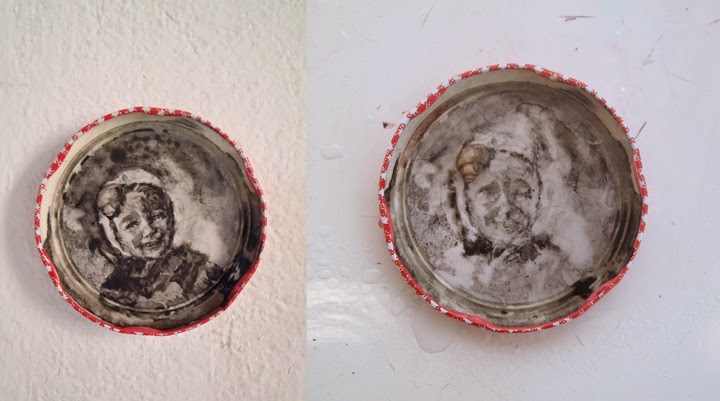
5.     Remains
Sumi ink and shell in jar lid, washed, 2012

6.     Shells
Spoon in glove of easel, 2012
Oxide on egg shell, 1998-present

7.     Unstable (Us, Them)
Unfired clay in water, 2014
Oil on canvas and wall, 2001


Sunday, July 6, 2014

launched my website!
mamatereza.net

Sunday, June 29, 2014


Letting the rain wash away her scream

And she only sleeps when it's raining
And she screams and her voice is strained...


Saturday, June 28, 2014

Unstable Foundation

Ani's direct presence, present, a present


Thursday, June 26, 2014

dream

We are at sea level and see a tsunami coming. We run hand in hand up to higher ground. Others have not yet seen the large wave. We get higher and higher. I know we will be safe even as the tip of the wave might get us wet. I know I will hold my mother's hand even if we go under water.

After, we see a couple completely oblivious to the situation sitting in a cafe.

Monday, June 23, 2014

In Light, reflection

In reviewing my work this past month, I notice and create an a. angry mark, b. the girl trapped within the man, and c. the fold of the fabric expresses more the content than the face itself.

a.

b.

c.

 I also notice how very few of the heads see with eyes open. It is a reflection of working from digital imagery where the eyes are mere shadow. On another level, I am feeling my way, just like the woman blind-folded, in the image of Automatic Writing. Sometimes, it is not the eyes that sees; for example, feeling my infant startle on my back as a crescendo comes on pandora and pierces his nap, I lower the volume. 

Sunday, June 22, 2014

In Light Of


this virtual residency,

the Carl Andre exhibit I just experienced,
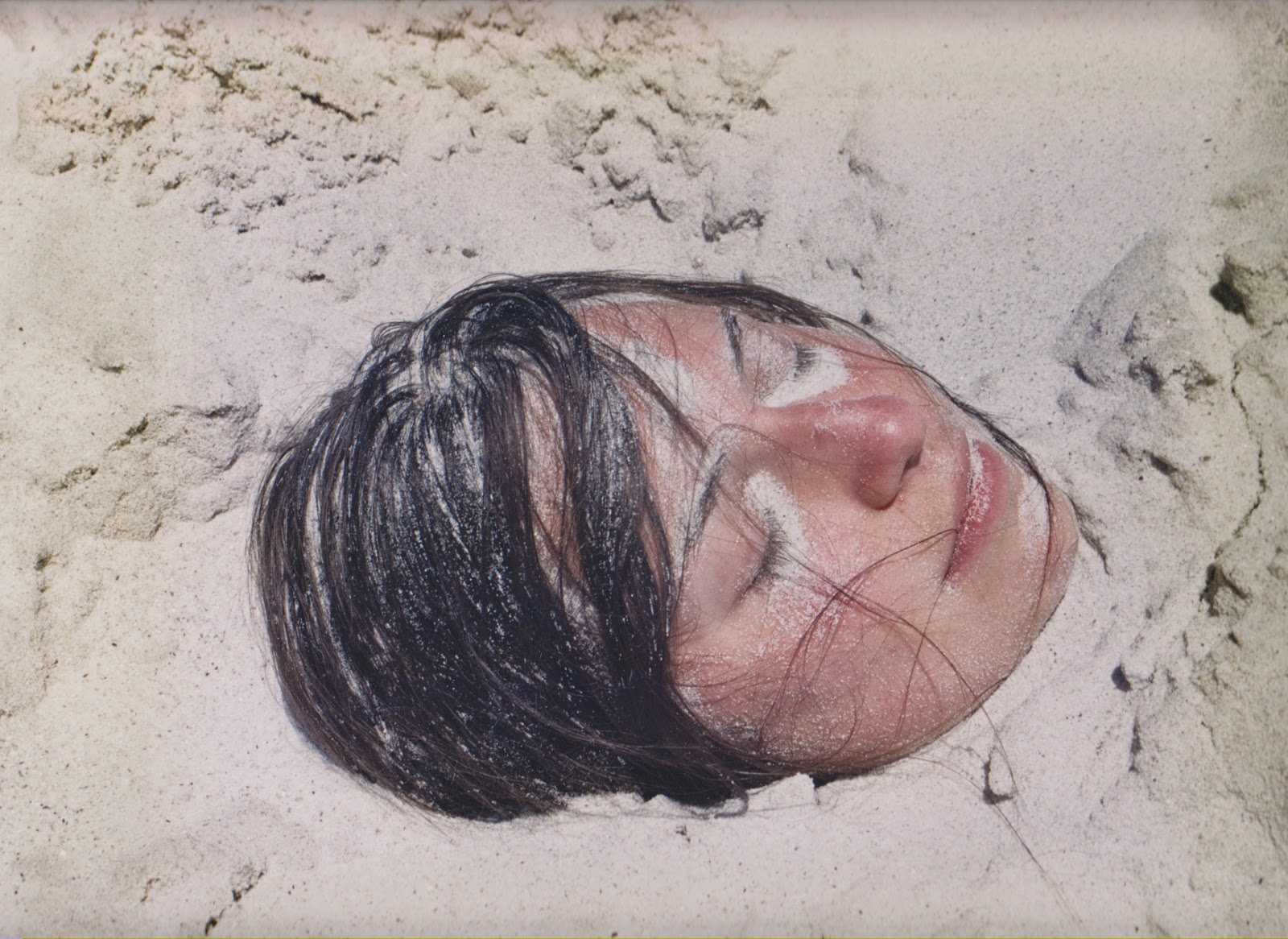
all of a sudden missing Ana Mendieta more,
searching for the 50 Steps exercise, which I just found after looking for it for over 2 hours, after
finding so many notes, articles, letters from workshops from 1996 onward (!), I am totally overwhelmed and also totally energized. I realized this weekend that I haven't necessarily taken my studio practice that seriously, and have not truly fulfilled my own potential as an artist. This isn't a self judgment; I can see it in my work. 
How can I change this? 
What can I throw away? 
What can I keep? 
Do I believe in what I'm doing?
What are my references? 
What am I studying? 
Why am I an artist? 
What am I commenting on? 
What do I want to say?

Neil Postman came to mind, especially The End Of Education. So I looked him up to find out more about his work. I didn't realize he helped craft the Inquiry Method for teaching and learning. So interesting!


From Wikipedia, the free encyclopedia
  (Redirected from Teaching as a Subversive Activity)
Inquiry education (sometimes known as the inquiry method) is a student-centered method of education focused on asking questions. Students are encouraged to ask questions which are meaningful to them, and which do not necessarily have easy answers; teachers are encouraged to avoid giving answers when this is possible, and in any case to avoid giving direct answers in favor of asking more questions. The method was advocated by Neil Postman and Charles Weingartner in their book Teaching as a Subversive Activity.
The inquiry method is motivated by Postman and Weingartner's recognition that good learners and sound reasoners center their attention and activity on the dynamic process of inquiry itself, not merely on the end product of static knowledge. They write that certain characteristics are common to all good learners (Postman and Weingartner, 31–33), saying that all good learners have:
  • Self-confidence in their learning ability
  • Pleasure in problem solving
  • A keen sense of relevance
  • Reliance on their own judgment over other people's or society's
  • No fear of being wrong
  • No haste in answering
  • Flexibility in point of view
  • Respect for facts, and the ability to distinguish between fact and opinion
  • No need for final answers to all questions, and comfort in not knowing an answer to difficult questions rather than settling for a simplistic answer
In an attempt to instill students with these qualities and behaviors, a teacher adhering to the inquiry method in pedagogy must behave very differently from a traditional teacher. Postman and Weingartner suggest that inquiry teachers have the following characteristics (pp. 34–37):
  • They avoid telling students what they "ought to know".
  • They talk to students mostly by questioning, and especially by asking divergent questions.
  • They do not accept short, simple answers to questions.
  • They encourage students to interact directly with one another, and avoid judging what is said in student interactions.
  • They do not summarize students' discussion.
  • They do not plan the exact direction of their lessons in advance, and allow it to develop in response to students' interests.
  • Their lessons pose problems to students.
  • They gauge their success by change in students' inquiry behaviors (with the above characteristics of "good learners" as a goal).

References[edit]

  • Postman, Neil, and Weingartner, Charles (1969), Teaching as a Subversive Activity, Dell, New York, NY.

Further reading[edit]

  • Awbrey, Jon, and Awbrey, Susan (1995), "Interpretation as Action: The Risk of Inquiry", Inquiry: Critical Thinking Across the Disciplines 15, 40-52.Eprint

Yesterday, today

Yesterday 
-2 year old birthday party from 9-11am
-Met M and C at Carl Andre exhibition at Dia: Beacon.
-Opening reception of Worlds Of Wonder at the Dorsky Museum.

The Dia exhibit was incredible, intense, all-encompassing, expansive, quiet, powerful, and captivating.

However, I never knew the back story that Andre was charged and later acquitted of murdering his wife, the artist Ana Mendieta. A book was written about it five years after the incident. From the NYTimes: NAKED BY THE WINDOW: The Fatal Marriage of Carl Andre and Ana Mendieta, by Robert Katz.

Apparently this retrospective was protested by many artists in front of Dia in NYC, via Hyperallergic, here.

Knowing this about Andre, how is my reception of his work changed?
Does it effect how I understand his work?
How does it effect his contribution to art history?
I mean, to me it appears that he's made a bi-forked contribution: his own work to Minimalism over a 40 year career and that story..and also (potentially, allegedly) removing Mendieta from the story of art and Feminism and silencing her potential growth and development as an artist.

I only learned about Andre and Mendieta after returning from the opening at the Dorsky.
The show was good, well attended and well received. Some of the artists spoke about their work. I admire the curator's approach. C and M stayed for a while. I'm still interested to see how my piece develops, where the tableaus can go, what they are, and what I can learn from them.

Here are some images of my piece from the opening, thanks to Ruth Burkett


We were all exhausted after a 12 hour day, and fell asleep soon after eating ice cream cones on the front porch.

Today
I'm ordering the book about Mendieta and Andre. I want to know more.