Someone just shared this residency in Marfa.
Looked interesting, so I decided to look at past artists' work.
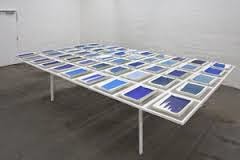
Found this artist, Tove Storch. Really love the simplicity and beauty of her work in blue, here.
Reading of performance here
Such a nice discovery today
x
Friday, June 20, 2014
Thursday, June 19, 2014
Looking at Looking at Your Questions
Can you be more specific when you say "subtle struggle" of living in a patriarchal world? How are you struggling specifically? Do you really feel that oppressed?
Yes, I feel defined/confined from the outside, especially in the term, the role, mother. (Most often by my family.) Other times by the situations that do not allow for children (working mothers) in their space.
What if there is no "outside", no "inside"...?
Could it be that you are dealing with family structure issues in relation to your own identity, and perhaps that's where you are feeling most confined? Also, why are you letting this role "define" you? I understand that your time at the VSC residency was less than ideal, but are there other environments where you would feel more supported in terms of bringing your children with you to work? And if not, why are you letting someone else's structure get under your skin like this? Is there something deeper that you may need to address...?
-What qualities about Nancy Spero's work do you identify with, and how are you actually protesting? How is leaving the sculptures on the ground a protest?
I identify with her severed heads, her empathy and accuracy of emotion within those tiny heads that she did in response to the Vietnam war, seeing those media images of that war for the first time.
empathy and accuracy of emotion ... those are really wonderful qualities in one's work. But perhaps she's pointing at the moon and you're looking at her finger...? Could there be another way to incorporate the empathy and accuracy of emotion, but translate into your own vocabulary...? I mean, if you're wanting to get angry, then get ANGRY and let that guide you. Look at Kara Walker, etc...
-What does your grandfather's molds have to do with Nigerian women exactly? What's the connection there?
I want to change patriarchy, one mold at a time, have my grandfather- who is just a stand in representative of patriarchy (although the reality was that he was the one who was gentle and kind throughout my childhood, and my grandmother who was the dictator.) But I want the definition of genders to shift. Patriarchy is passes on from thousands of generations.
Why do you want the definition of genders to shift?
A definition is just a man-made word that people agree has meaning.
It has no power over anything. If the idea of women's roles, or your role in particular in relation to Patriarchal hierarchy, is something that upsets you and you want to speak about, could it be that easy to just work from there? It seems like the way you are living your life with your husband and family is an excellent model of progressive living - outside of ascribed gender roles - that perhaps that naturalness could be conveyed through your work as well...?
The Greek general Meno wrote:
“Let us take first the virtue of a man—he should know how to administer the state, and in the administration of it to benefit his friends and harm his enemies; and he must also be careful not to suffer harm himself. A woman's virtue, if you wish to know about that, may also be easily described: her duty is to order her house, and keep what is indoors, and obey her husband.”
That pisses me off as well. And I'm Greek, so that is literally part of my heritage. I found that statement to be true when I visited my family there for the first time when I was 15. It was during that summer when I knew I was a feminist without knowing that the term "feminst" was. I just knew that that structure of oppression of women was NOT OK. Years later, I read the book WET, which helped deconstruct a lot of ... everything really regarding gender roles and the history of gender-based language that "we" take for granted. It might be a good read for you too.
It is this mentality that binds the Nigerian girls today.
All of us are responsible for perpetuating "this mentality".
It's like that saying: we are the problem and we are the solution.
-Why is it important to highlight the method of documentation? Why is enlarging the images important to you? What about impermanence gives you hope, and what does that have to do with protesting patriarchy?
The idea of impermanence is crucial as it means that patriarchy cannot do anything but change.
Exactly. Everything changes, decomposes, transforms. If this is an aspect that gives you hope, how can you work with it in relation to how angry the situation makes you? Can you work from a transformative place?
The enlargement means that the girls receive the presence they deserve.
I understand what you are saying...but to me, your statement feels like you're speaking for others. "receive the presence they deserve"...do you really mean you'd like to recapture a presence that you think you deserve, and are using the Nigerian women as a vehicle or metaphor for what you want for yourself? I'm trying to figure out what's really going on here.... If you need to be angry, then get angry and communicate that with empathy and accuracy of emotion. The statement feels like you're wanting to speak about something HUGE and not realizing that your own story might be the biggest gold you can ever wish for. I would encourage you to keep going with this, figure it out by working more and more and more. You may be working on a 3D mind map via this piece - keep it going! I'm so curious to see what comes next
Wednesday, June 18, 2014
Natural Breakdown
Looking at your questions:
-Why is it important to highlight the method of documentation? Why is enlarging the images important to you? What about impermanence gives you hope, and what does that have to do with protesting patriarchy?
Can you be more specific when you say
"subtle struggle" of living in a patriarchal world? How are you
struggling specifically? Do you really feel that oppressed?
Yes, I feel
defined/confined from the outside, especially in the term, the role, mother. (Most
often by my family.) Other times by the situations that do not allow for children
(working mothers) in their space.
-What qualities about Nancy Spero's work do you identify with, and how are you actually protesting? How is leaving the sculptures on the ground a protest?
I identify
with her severed heads, her empathy and accuracy of emotion within those tiny
heads that she did in response to the Vietnam war, seeing those media images of
that war for the first time.
-What does your grandfather's molds have to do with Nigerian women exactly? What's the connection there?
I want to change patriarchy, one mold at a
time, have my grandfather- who is just a stand in representative of patriarchy
(although the reality was that he was the one who was gentle and kind
throughout my childhood, and my grandmother who was the dictator.) But I want
the definition of genders to shift. Patriarchy is passes on from thousands of
generations.
The Greek general Meno wrote:
“Let us take first the virtue of a man—he should know how to administer
the state, and in the administration of it to benefit his friends and harm his
enemies; and he must also be careful not to suffer harm himself. A
woman's virtue, if you wish to know about that, may also be easily described:
her duty is to order her house, and keep what is indoors, and obey her husband.”
It is this mentality
that binds the Nigerian girls today.
-Why is it important to highlight the method of documentation? Why is enlarging the images important to you? What about impermanence gives you hope, and what does that have to do with protesting patriarchy?
The idea of impermanence is crucial as it means
that patriarchy cannot do anything but change. The enlargement means that the
girls receive the presence they deserve.
I realize:
I look at the expressions of the perpetrator/s
and break them slowly and naturally down.
A not so sure Aristotle.
Monday, June 16, 2014
Findings, From the Mold of my Grandfather, Untitled Girls
(working statement)
Similar to Nancy Spero, I see my work as a protest. It is
not a war that I am protesting directly, but a much more subtle struggle, that
of gender living under patriarchy. In Findings,
I press clay into a mold of my grandfather 232/243/272/292 times. The
number represents the over two hundred three hundred girls that went
missing two months ago this time in Nigeria. The clay is unfired, purposefully
left impermanent, as is all ground, philosophical or topographical. It is through this impermanence, I find hope. Each
portrait’s presence/present is captured in a momentary stasis in the form of an
enlarged digital print.
Saturday, June 14, 2014
re search, Whose ground is it?
After a bit more research this morning I came upon, " boko is a native Hausa word, originally meaning sham, fraud, inauthenticity, and such which came to represent western education and learning," from Paul Newman's http://www.megatchad.net/publications/Newman-2013-Etymology-of-Hausa-boko.pdf
I think of this in terms of the British, Catholic school in Prague that I taught at last year. Albeit a beautiful school with caring staff, the school wipes away most of Czech culture. It really does not take much interest in learning local customs, language or culture. It has a very colonial, business mindset. (They also had talks with Sierra Leone to expand the program in Africa.)
I'm thinking of education as power, especially as we go to write lesson plans for the upcoming classes. Who's information are we reproducing? How are we subverting that information? Is there grounding in nature?
Thinking about the shift in perspective of the ground every time I document a portrait- the canvas, or drop cloth that supports the clay. Each time the weave is from a different angle. (I need to look and work with this ground more closely as well as the paper it is printed on.)
I think of this in terms of the British, Catholic school in Prague that I taught at last year. Albeit a beautiful school with caring staff, the school wipes away most of Czech culture. It really does not take much interest in learning local customs, language or culture. It has a very colonial, business mindset. (They also had talks with Sierra Leone to expand the program in Africa.)
I'm thinking of education as power, especially as we go to write lesson plans for the upcoming classes. Who's information are we reproducing? How are we subverting that information? Is there grounding in nature?
Thinking about the shift in perspective of the ground every time I document a portrait- the canvas, or drop cloth that supports the clay. Each time the weave is from a different angle. (I need to look and work with this ground more closely as well as the paper it is printed on.)
Friday, June 13, 2014
Thursday, June 12, 2014
A wave from Anitra (at the Millay Colony)
So just as I unpacked my tools, notes, clay, doilies, penises, and our journals, I found that at the back of Ani's and my sketchbook her hand folded (in the move) in such a way that it waved at me throughout the residency.
I also found the following on the cover of Patti Smith's Statues, right as I sat down to sculpt. (Ani & I wrote in a journal within Patti Smith's series titled "Trois")
(I must think about getting these (re)published with our dialogue, notes and tidbits one day.)
Wednesday, June 11, 2014
published comments
I just found all of the published comments from this blog!
I never really knew anyone commented - they're amazing
you're so encouraging xo
I never really knew anyone commented - they're amazing
you're so encouraging xo
Monday, June 9, 2014
cultural safari
Dear Tereza,
Your residency photos look really interesting so far.
Can't wait to hear more...
I just got back from a 5-day trip/wedding in North Carolina.
1750 miles there and back, in car with bambino. What a great traveler!
I thought of the trip as a cultural safari with a wedding in the middle of it. It was so interesting to see all the changes of topography, foliage, clouds, etc along the way...and also to notice the tendency towards homogeny by way of box stores, gas stations, road widths and sizes, and cars. I also realized, very early on, that when I moved out of NYC, I moved to America. Most of what I saw looked and felt familiar: country life, agriculture, stand-alone housing (for the most part).
It was interesting to correlate seemingly disparate aspects of nature in relation to one another. Two aspects of the same thing in the same space! And to notice when one really did NOT relate to the other. I found Pennsylvania very depressing: we drove past Mechanicsville, Carbon County, and Fracktown. Everyone we saw looked a bit grey. But the Blue Ridge Parkway was fantastic: we stopped for lunch on the side of the road at an apple orchard, and there was a country music band playing for Sunday brunch. Some older couples were dancing as couples, and looked very happy. We ate overlooking the Smoky Mountains.
It was like the big arteries of road were very much the same along the way, but once we got onto back roads, in the capillaries of the country, the houses were more individual, largely blue collar, and seemed- at least to me - more honest: a little more rough around the edges, no shiny coats of paint or perfectly manicured lawns; the roads were a little more unkept, there was a little more mystery behind each turn. Grass was long along the roadsides, and we could see miles of wildflowers growing like carpet. However, on the highways, the grass was cut super short, and the dividers were mostly made of concrete; Walmarts and BP Gas stations were numerous, as were Hampton Inns, and Econo Lodges. And God. Crosses everywhere, Bible verses on billboards, and God on the radio.
But it's all our own choice - as humans, I mean. We choose to support Walmart, we choose to live in Carbon County, as much as we choose to support the Blue Ridge Highway system and eat organic produce. I find it pretty fascinating, sometimes pretty underwhelming, often depressing, but sometimes also uplifting and hopeful...under the larger umbrella of Earth and our role in the Universe.
Why do we make these decisions? Can prevailing thoughts that create the box store mentality be shifted towards a more holistic approach to integrating with nature rather than ignoring its value? I have so many questions like this...why don't we choose to see ourselves as the same as not only each other, but as nature? What will have to happen to suture, to transform the separation within ourselves? What are we as a people so afraid of?
And even though it was nice to go on a road trip, it's amazing to be home! It's lovely and just right. I loved seeing our garden again, and our unmowed grass, my leaky studio and our dusty bedroom. I appreciate the luxury of having my own space that is cultivating food for my family, sheltering us from weather, and affording us the peace and relative quiet of country life. Sad to see a handful of bees in the catmint rather than hundreds, but perhaps I will start raising bees next summer to compensate...?
xo
Angela
What if, we were all told at the age of two that we were as important as the Dalai Lama, and were destined to what lay ahead? (Of course, the practical training must be a part of it. But what would that seed spark in humanity?)
(substitute your picture here)
PS Today I feel like a child. One that plugs the toilet and for fear, shuts the lid, hoping it will not overflow. (I wonder if the Dalai Lama ever felt like that?)
Sunday, June 8, 2014
reflections from the day
time does not matter
20 clear minutes in the studio (realistically 2 hours) is plenty
what is one (re)presenting?
In terms of
repetition
reproduction?
(such a strange word! Really? When making children are we really "manufacturing from components or raw materials." or "cause (a particular result or situation) to happen or come into existence.")
thoughts from
molds of my grandfather
playing with heads
Is the individual important?
Yes, only in relation to the whole.
Of course, it is impossible to repeat. Every texture of air, various vibrations, the way the guitar string cuts through the clay, nothing is ever repeated.
Yet, there are patterns. I am listening to nature's patterns here, again. I want to follow those in my daily life.
tablecloth as
grandmother's doily
as snowflake.
I'm also learning that what we call leisure
is just as important to the creative process
as what we call work.
Bowing to your natural self
As I hear the sounds of distant birds, the ones close by, the flies buzzing, the mosquitoes at short range around my ears, one bird hopping in the distance, and very little wind (just high in rustling the topmost branches,) I am in awe of the orchestration of it all.
There is such balance to it. Everyone just doing what they do. (I'm sure there is violence within and death and gore, however it is not the predominant force.) Or maybe if I truly observed this micro-cosmos more closely all would be there and more.
I am in love with the seeming serenity.
There is such balance to it. Everyone just doing what they do. (I'm sure there is violence within and death and gore, however it is not the predominant force.) Or maybe if I truly observed this micro-cosmos more closely all would be there and more.
I am in love with the seeming serenity.
Saturday, June 7, 2014
today at Millay
On being nourished and fed...
A love letter to Edna, (Ani, and other immortal souls,)
Dearest loves,
I am on the verge of tears, the field covered in wildflowers, vibrating chirps in rustling leaves. Your souls laid down this land, as did those of Native Americans before you. What a gift for me now! Space, to clear, space to connect, reflect. I well up again and again thinking of you.
The blueberries taste fuller, the hummus as I have never tasted before! I will drink a toast to you tonight!
If I do nothing but sit here for the next three days, claim this space, this time, and breathe your air than I have done all right.
In-between the sit, this luxury, I vow to bring the children here. (Not my literal children, but those through metaphor, through the mold of my grandfather, those not free, not privileged, not child free.) For every body deserves the chance to sit, to look, to see, to hear beauty and feel a part of that beauty.
A love letter to Edna, (Ani, and other immortal souls,)
Dearest loves,
I am on the verge of tears, the field covered in wildflowers, vibrating chirps in rustling leaves. Your souls laid down this land, as did those of Native Americans before you. What a gift for me now! Space, to clear, space to connect, reflect. I well up again and again thinking of you.
The blueberries taste fuller, the hummus as I have never tasted before! I will drink a toast to you tonight!
If I do nothing but sit here for the next three days, claim this space, this time, and breathe your air than I have done all right.
In-between the sit, this luxury, I vow to bring the children here. (Not my literal children, but those through metaphor, through the mold of my grandfather, those not free, not privileged, not child free.) For every body deserves the chance to sit, to look, to see, to hear beauty and feel a part of that beauty.
Friday, June 6, 2014
studio packing/transport
studio visitors
packing list:
clay
tools (manicure set and pins)
pot
brushes, pencils
tape
grandmother's gauze, doily, and coffee cup
fifty or so heads
mirror
baby powder
Anitra's soap screaming
little red books
sketchbook and Edna's book of letters
dozen or so prints
clay boards
sketch for an unknown thing
bringing girls home (sadly only through metaphor)
Working with images of 223 girls from Nigeria
printed on 13 x 19 (faces are approximately the size of a child/young adult.)
Taken from and photographed with a mold of my grandfather.
Wednesday, June 4, 2014
Tuesday, June 3, 2014
Inspired by your toilet paper!
(Image taken from Maya's studio)
printing these large on 13 x 19 paper
heads are slightly larger than lifesize
Also inspired by
"Repetition as meditation on impermanence."
Monday, June 2, 2014
Do you know how important you are?
"Do you know our people
slept, laying spoon fashion in the filthy holds of slave ships, in their own
and in each other’s excrement, and urine, and menstrual flow so that you could
live two hundred years later?
Do you know that?
Do you know our people
stood on auction blocks, so that you could live?
When's the last time anyone told you, how important you are?"
-Dr. Maya Angelou
(From Dave Chappelle Maya Angelou Iconoclasts 4 of 4 2006, time 6:20)
Sunday, June 1, 2014
Practice reflection
On the eve of our virtual residency, I reflect on my studio practice.
What are the overarching themes, if any?
Do I recognize what I am doing, what I have done?
What is my work communicating?
Some thoughts, to perhaps be translated into an updated artist statement in the near future...maybe even this month.
My work is informed by commonplace routines of domestic life, notions of interconnection, and impermanence and loss.
Through painting, performance, and object making, I place two aspects of the same thing in the same space, drawing connections between seemingly unrelated ideas, images, and forms.
I work with materials that are fragile to reveal my own vulnerability: porcelain, paper, glass.
I find strength in working in series, and embrace deviation, even in things that are decaying.
My work is influenced by Feminism, and Minimalism.
I can't see how much it is influenced by Dada or John Cage, but there is deep admiration for the bravery of both.
Repetition as meditation on impermanence.
I work with discarded and overlooked items to equate the value of all things.
I work with domestic actions like cleaning to bring to light what we as a community take little notice of, and highlight the ethos of human condition.
How can a performance of sweeping the streets be communicated as an aspect of meditation?
How can a meditative act of beading or embroidery also be considered a performance, or a drawing?
How can a painting speak of anger and stillness at the same time?
What is the stain of memory?
Subscribe to:
Posts (Atom)